
Fabric basics
Woven Fabric Defects: Where Each One Comes From
A defect-origin map for uniform fabric: which faults start at the yarn, which at the loom, and which in dyeing or finishing, and what that means for who can actually fix them.
Jump to section
Quick answer
Most woven fabric faults can be traced to one stage: the yarn, warp preparation, the loom, dyeing, or finishing. Knowing which stage a defect comes from tells you who can fix it and whether it can be corrected at all once the cloth is finished. Some faults, such as a crease heat-set into polyester, cannot be reversed later.
Why the origin matters more than the name
When a roll arrives with a fault on it, the useful question is not what it is called but where it happened. A fault introduced at the yarn stage runs through the whole lot. A fault from a single loom stoppage sits at one point along the length. A fault created in finishing may affect every roll processed in that batch, including rolls woven weeks apart.
That distinction also tells you whether a fix is possible. A shade issue caught before finishing can often be corrected. A crease heat-set into a polyester blend cannot be pressed out afterwards, because the fiber has been set in that shape.
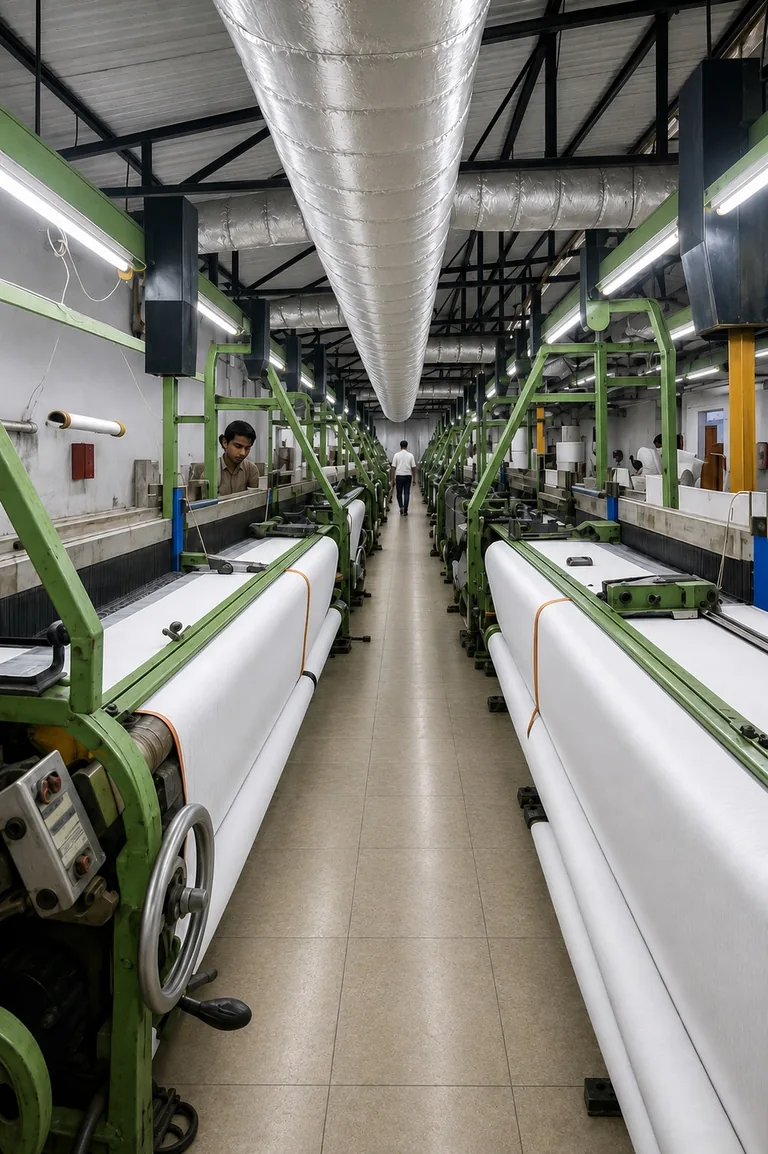
We weave in-house at our own unit in Atoon and send cloth to processing partners in Bhilwara for dyeing and finishing. That split is the reason we can tell a buyer which stage a fault came from rather than treating the whole run as one black box.
Defect origin map
| Defect | What you see | Where it starts |
|---|---|---|
| Slubs and thick places | Raised thick sections in individual yarns | Yarn |
| Reed marks | Fine lengthways lines spaced across the width | Weaving |
| Starting or stop mark | A line across the width where the loom restarted | Weaving |
| Broken, double or missing picks | A gap, or a doubled weft line, across the width | Weaving |
| Missing ends | A continuous thin line running along the length | Warping or weaving |
| Weft bar | A band across the full width, often a shade difference | Yarn or weaving |
| Temple mark | Distortion or pin marks near both selvedges | Weaving |
| Oil stain | Dark spot or smear, often repeating | Weaving |
| Crease mark set into the cloth | A permanent line that will not press out | Finishing |
| Bow and skew | Weft or pattern curved or sloping across the width | Finishing |
| Shade band across the width | Centre reads different from the selvedges | Dyeing or finishing |
| Shade band along the length | Shade drifts from one end of the roll to the other | Dyeing or finishing |
This is an origin map, not a severity ranking. A single small oil spot may be trivial on a workwear order and unacceptable on a white shirting one, which is why inspection is graded against the end use rather than against a universal pass mark.
The faults that start at the loom
A starting mark appears because the warp relaxes while a loom is stopped. When the loom restarts, the cloth fell has drifted, and the first picks after the restart sit at a different density from the rest. Whether it reads as a thin line or a thick one depends on whether the tension at restart was lower or higher than normal. Longer stoppages make it worse.
Reed marks come from the reed itself: bent or unevenly spaced wires leave lengthways lines where the warp ends are grouped slightly wrong. Temple marks appear at both edges because the temple grips the cloth there to hold it out to width.
These are the faults we can see and act on at our own weaving floor, before greige cloth leaves for processing.
The faults that start in dyeing and finishing
Bow and skew are pulled into the cloth wherever tension is uneven across the width. The correction has to happen before the cloth is gripped for setting, because once it is held in a distorted position and set, the distortion is locked in.
Shade banding across the width usually traces back to uneven conditions across the machine rather than to the dye recipe. A polyester blend dyes according to how the fiber has been set, so uneven temperature across the width changes how much dye each part of the cloth takes up. That is the mechanical link between a setting fault and a shade band.
Creases follow the same logic. A rope crease that is cooled quickly in a thermoplastic fiber is set in the same way a pleat is set deliberately, and no amount of pressing later will remove it.
These stages run at our processing partners. What we do is check the returning lot against the approved reference standard before it is warehoused, so a finishing fault is caught at the mill rather than at your cutting table.
What to do when you find a fault on delivery
- Photograph it with something for scale, and note how far along the roll it sits and how far in from the selvedge.
- Check whether it repeats. A repeating fault points at the machine, a one-off points at an event such as a stoppage.
- Check whether it appears on more than one roll. Across rolls points at yarn or at a processing batch, one roll points at one loom.
- Say whether it is within the cuttable width or in the selvedge zone you were going to lose anyway.
- Raise it before cutting. Once the cloth is cut the origin becomes much harder to establish and the remedies narrow.
Our guide on how to inspect uniform fabric on delivery covers the receiving check itself in more detail.
A note on point-based inspection systems
Fabric inspection is commonly scored by assigning penalty points to each defect according to its length, and totalling them over a set area. Buyers and mills then agree a threshold above which a roll is rejected.
Two things are worth knowing. The scoring method and the acceptance threshold are separate: the method comes from a published standard, the threshold is a commercial term you agree in your contract. And a widely quoted threshold figure is trade convention rather than something written into the standard, so put the number you want into your purchase order instead of assuming it applies by default.
The failures that only show up in the garment
Everything above is found on the inspection frame. A separate class of problem passes roll inspection cleanly and appears only once the cloth has been cut and sewn, because it is a property of the fabric rather than a mark on it. No amount of looking at the roll will catch any of them.
Seam slippage is the clearest example, and the one most often blamed on the stitching unit. Yarns move away from a stitched seam under load, opening a gap along the seam line while the sewing thread stays intact. It comes from the cloth, so it is tested rather than seen.
| Failure | How it shows | Where it comes from | How to catch it before bulk |
|---|---|---|---|
| Seam slippage | Yarns pull away from the seam under load, opening a gap with the thread intact | Slick fibre, low sett, or a finish that lowers yarn-to-yarn friction | Seam slippage test on the fabric, plus a stitched sample loaded at the stress seams |
| Low seam strength | The seam gives way before the fabric does | Yarn strength, or a stitch, thread and needle combination wrong for the cloth | Seam strength tested alongside tensile and tear on the fabric |
| Needle cutting | A line of small holes along a stitch line | Blunt or wrong-gauge needle against a tight or heavily finished cloth | Stitch the fit sample on the machines that will run the bulk, not on a sample machine |
| Puckering after wash | Seams ripple after the first wash while the panel beside them stays flat | Fabric and sewing thread shrinking at different rates | Wash the stitched fit sample, not only a swatch |
| Pressing shine at seams | Glazed marks where seams are pressed open | Thermoplastic fibre content meeting too much heat or pressure | Press the fit sample at the settings the garment unit actually uses |
The common thread is that a swatch cannot show any of them. Each needs either a fabric test with a named method or a garment stitched from the approved lot, which is why the fit sample is worth the fabric it costs. See uniform fabric sampling for what to ask for and when.
FAQ
Frequently asked questions
- What causes bowing in a checked or striped uniform fabric?
- Uneven tension across the width during wet processing and setting, which pulls the centre of the cloth ahead of the edges or the reverse. It is most visible on checks and stripes because the pattern makes the curve obvious. It has to be corrected before the cloth is held and set, since setting locks the distortion in.
- Why does a crease sometimes refuse to press out?
- Because polyester is thermoplastic. If a crease is present while the fabric is hot and it is then cooled quickly, the fiber is set in that shape, in the same way a deliberate pleat is set. Later pressing at normal garment temperatures will not undo it.
- Is a shade difference between the middle and the edges a dyeing fault or a weaving fault?
- Almost always a wet-processing one. It usually reflects uneven conditions across the width of the machine rather than the dye recipe itself, since the recipe is the same across the whole piece.
- Can every fault be identified after the fabric is finished?
- Not always with certainty. Some faults look similar whatever their origin, and finishing can mask a weaving fault or make it more visible. This is why the pattern matters: whether the fault repeats, whether it appears on one roll or several, and where it sits along the length.
- Which of these stages does Benny Cotts run itself?
- Weaving, at our own unit in Atoon, Bhilwara. Dyeing and finishing run through processing partners in the region. We check the returning lot against the approved reference standard before despatch, so faults from either stage are caught at the mill.
- The fabric passed inspection but seams are opening in the finished garments. Is that a fabric fault?
- Usually yes, and the name for it is seam slippage. Yarns move away from the seam under load because the fibre is slick, the sett is low or the finish reduced yarn-to-yarn friction, and the sewing thread stays intact throughout, which is what separates it from a stitching fault. It is a property of the cloth rather than a mark on it, so no inspection frame could have caught it. Ask for a seam slippage test result on the fabric, and for a stitched sample loaded at the stress seams, before bulk cutting rather than after.
Cite this guide
Quoting this page? Paste the line below so the credit links back.
<a href="https://www.bennycotts.com/guides/woven-fabric-defects-causes-and-who-fixes-them">Woven Fabric Defects: Where Each One Comes From</a>, Benny Cotts, 2026Updated 6 September 2026 · Benny Cotts, Bhilwara
Fabrics
Fabrics mentioned in this guide
Spec, price and MOQ on every fabric page.
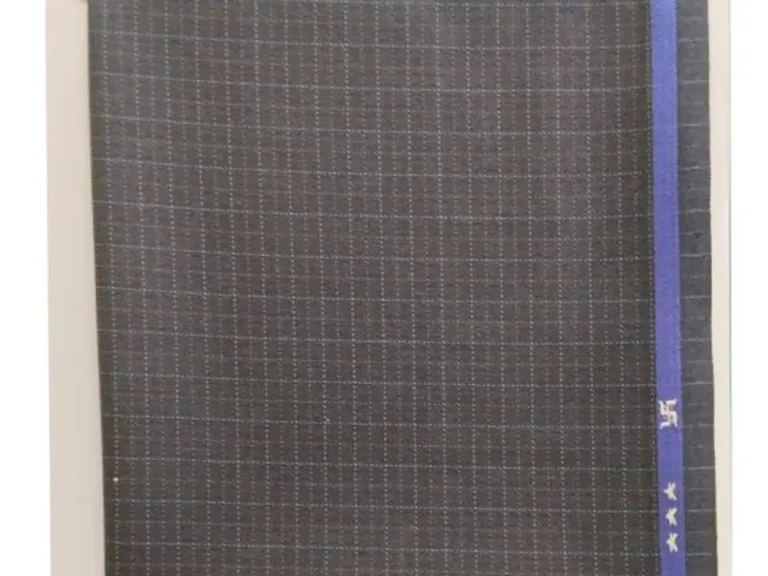
Panto
Poly-Viscose blend · 215-235 GSM
Workhorse trouser fabric with consistent dye lots.
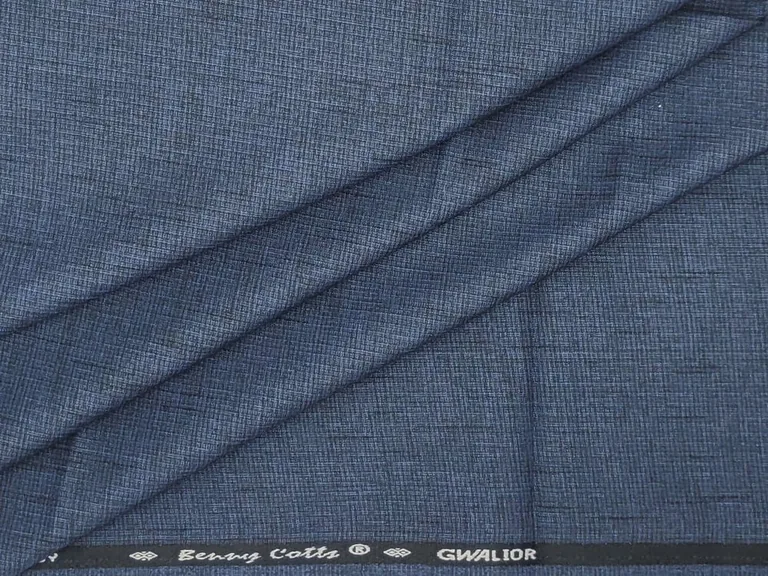
Nano
Poly-Viscose blend · 180-200 GSM
Our entry-level uniform fabric for large-volume programs.
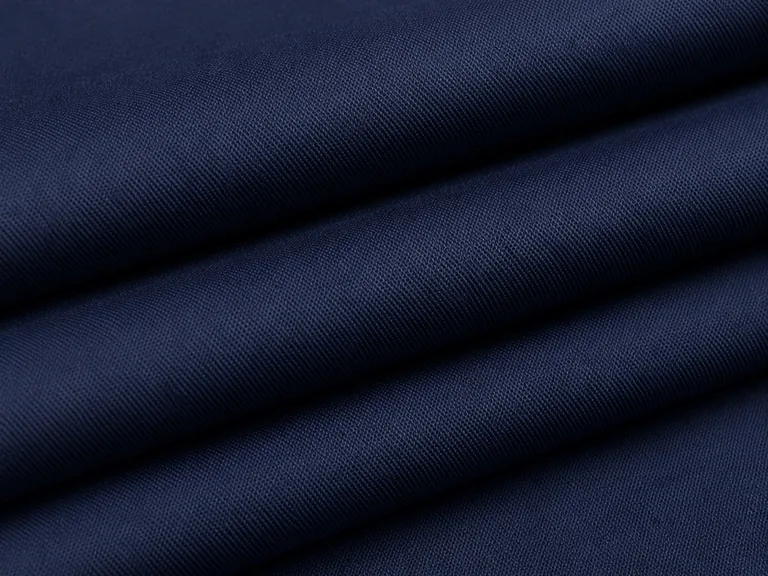
Denim HV
Poly-Viscose 70/30 · 235 GSM
Poly-viscose denim-look uniform cloth with a rugged handle.
Industries this applies to
Uniform programs these fabrics are used for
- Fabric for Corporate Trousers
- Fabric for Sports & PT Uniforms
- Fabric for Patient Gowns
- Fabric for Hospital Staff Uniforms
- Fabric for Ground Staff Uniforms
- Fabric for Army Uniforms
- Fabric for Police Uniforms
- Fabric for Security Guard Uniforms
- Fabric for Industrial Uniforms
- Fabric for Construction Workwear
- Fabric for Housekeeping Uniforms
Fabric types covered here
Keep reading
Related guides

Ready to place an enquiry?